

HOW TOPE OLOWONIYAN LEARNED TO DISAPPEAR ON PURPOSE
From a three-character audition that finally got her noticed to a steam room ritual that brings her back to herself, the Nollywood actress has built a career on knowing exactly which parts of herself to release, and which to keep. Tope breaks down her craft and journey on The Joey Akan Experience.
There were three characters in the scene, and Tope Olowoniyan played all of them.
It was 2020, and she had spent years as the actress who supported the lead, the one who could be trusted to hold a scene but not yet carry one. She wanted more. So when it came time to audition for King of Boys, she didn't send in a tape. She built a production. "There were three people in the scene, and then I played all three characters," she says, " it gave me the visibility that I needed at the time." She got, in her words, "red cameras", a full crew, lighting, the works, for an audition nobody had asked her to overproduce. It worked. People who had never clocked her name started asking who she was. That, she says, is where growth actually comes from in Nollywood: not socializing your way into a room, but doing something undeniable enough that the room starts asking about you.
The Supporting Actress Problem
Before the audition, Olowoniyan had a clear read on what was happening to her career. She was good, reliable, and in danger of being boxed in. "I knew that I was at a place in my career where I wanted more. I didn't want to be boxed as that supporting actress that could support the face,” she says." It doesn't mean that there's anything wrong with supporting, but “if you want to grow, you have to take on more responsibility."
So she took it. The three character audition landed her the visibility she needed, and from there, the harder part began: proving the visibility wasn't a fluke. "When you see that, oh yes, it's working, you start to put in more work to match the opportunities that you're given."
Why She Asks Before She Says Yes
Years and a King of Boys cycle later, Olowoniyan has the leverage to be selective, and she uses it. Before she commits to a project now, she runs through a short, deliberate list: "Who is directing? Who is producing? Who am I acting with? Who is this actor in this scene? Not out of difficulty,” she says, but because "everything just has to make sense."
It's a defense mechanism as much as a strategy. She points out, filmmaking is a community project in a way that music often isn't, a musician can write, perform, and release alone, but a film answers to the slowest department, the least reliable investor, the producer whose returns never came in.
She's lived the downside of that math personally: a Netflix series she shot sat finished for two years before release, its budget quietly eroded by a naira that kept losing value while the project waited on a release date nobody controlled.
"Sometimes it can just be one department dropping the ball that can make the owner of the project just say, you know what, I'm just going to have to step back," she says. Vetting a project before saying yes isn't paranoia. It's how you avoid giving two years of your mornings to something that might never see a screen.
The Craft of Disappearing
What makes Olowoniyan compelling? She painstakingly takes the actual work of becoming a character.
In an action role, she chose a less-travelled path. When a director offered to go easy on her in rehearsal, she went straight for a full push-up instead of the modified version he expected. "You don't know that I cannot do a full push-up,"she says, half-joking, but the point lands: she wanted the fight choreography to be earned. She practiced boxing to understand how adrenaline affects the human body mid-strike, then built her character a full interior life to justify it. The character? A woman who murdered roughly twenty people, the first of them the man who raped her. "You build a backstory that fills your performance, that fills the emotions, the reactions, the snacks, the looks," she says "not just what is written on the script."
That same rigor turns inward in quieter moments. Filming Between Silence and Truth opposite Daniel Etim Effiong, she played a mother grieving a child lost in an accident that had also taken her memory. The production shot the happy scenes first, a child alive, a room full of play, and kept her out of the torn down version of that room until the day she had to walk into it for real. "The moment she enters it, she remembers everything," Olowoniyan says. "I started to touch the walls. I held her teddy, and I remembered what it meant to my character's child." She needed two days afterward just to come back to herself, which is when the sauna became part of her process, not self-care exactly, but what she calls performance care. "To be able to do that, you have to actually know yourself," she says. "You have to be your friend. You have to know the things that are authentically you, so you don't carry pieces of a character to your real life."
Business, Not Betrayal
Olowoniyan is just as direct about the parts of the industry most people won't say out loud, including what happens when friendship and business collide. "Instead of just cutting people off, you could have a very serious conversation about growth, about where I want to go," she says. "If your friend is wise enough to see that this friendship should be beneficial, not just being friends, they should also be mature enough to have that conversation." It isn't coldness, in her telling, it's honesty about the fact that a loan has a timestamp, a producer needs a return, and value and familiarity are not the same currency.
Fulfilling My Purpose
Asked, near the end, what actually drives her, the business instinct or the art, Olowoniyan doesn't split the difference. "I think the principal driver for me is just fulfilling my purpose," she says. "I live a very intentional life. I'm very present in my realities. I pretty much discovered myself very early, and at very unique points, I'm just like, I don't want that, and I'm just going to do what I need to do to change it."
It's the same instinct that built a three-character audition out of nothing, that pushed through a full set of push-ups she wasn't asked to do, and that sends her to a steam room after every role that takes too much. Olowoniyan isn't waiting to be plugged in. She's already decided what she wants, and she's working out, scene by scene, exactly how to become, and then stop being, whoever the story needs her to be.
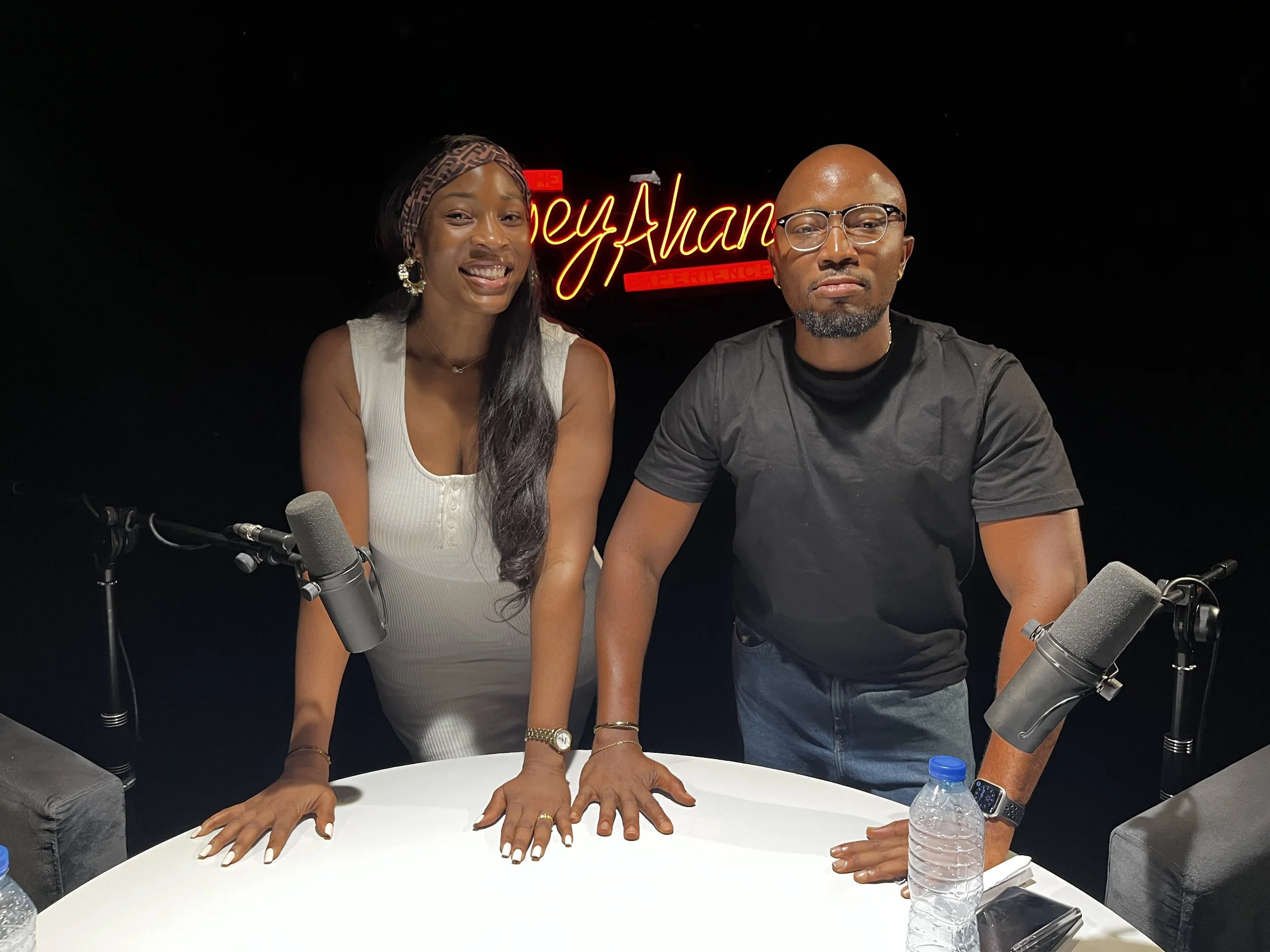
Left to Right: Tope Olowoniyan (Nigerian Actress and FIlmmaker) and The Joey Akan Experience host, Joey Akan
____________
The Joey Akan Experience was created by Joey Akan and produced by Úrú Collective. Úrú Collective is a talent management and media production company working with talent, brands, and culture across Africa.