

The Chess in Slums Africa founder on turning pain into purpose, winning over the area boys, selling a ₦1 million chessboard, and what fame costs.
"I didn't choose chess. Chess chose me."
When Joey Akan asks what anchored a boy from a Lagos slum to something as unglamorous as chess, Tunde Onakoya answers with a line that explains the rest of the conversation. "What I really wanted to do was charity. But I was a charity case myself." The founder of Chess in Slums Africa sat down on The Joey Akan Experience to talk about pain, the seven years nobody cared, the day the world finally did, and what being seen has cost him.
Pain Isn't the Point. Meaning Is.
Joey puts a theory to him: the outliers, in business and everywhere else, almost always come from pain. Why? Tunde disagrees with the premise. "It is not the pain in itself that is the prerequisite for doing something truly remarkable in the world," he says. "It is how we're able to construct meaning from it." Two people can suffer the same loss and leave with different understandings of it. The pain doesn't go away, he says. It lingers, and you keep confronting it. But "your pain must not be wasted. It must be constructed into something deeply meaningful." For Tunde, the mission starts where his pain meets someone else's suffering, and it becomes about trying to "protect other people from going through that same pain."
A Chessboard in a Barbershop
He grew up in a corridor in a small slum community, in a place "where nothing happens." When he went back to film a documentary about his story, nothing had changed. "It felt like a museum of who I was," he says. His old friends watch him on TV and are proud of him, and it broke him, because it showed him how lucky he'd been.
His path had been chosen for him from the age of five. He was the first child, so naturally he would become the doctor who saved the family from poverty. His parents worked tirelessly to provide for their family. His mother swept streets, and his father drove a danfo. At age 10, the money ran out and he had to drop out of school.
Wandering around at home with nothing to do, he walked into a barbershop and saw a chessboard for the first time. The barber played competitively, at National Master level, and the shop doubled as a game centre for boys. "It was love at first sight," Tunde says. Chess looked like "a silent conversation" the barber was having with himself. He wanted to be smart. His English was weak, his self-esteem was low, and he didn't think he was good enough. So he moulded chess pieces out of clay, drew a board on cardboard and taught his brother to play. Eventually the barber invited him to a game. He lost in two moves, and the barber gave him a book.
It gave him something else, too. "I couldn't control all the other outcomes of my life, whether I would go to bed hungry,"he says. "But the one thing I could control was what was within this magical 64-square template. If I play well, I'd win. If I play badly, I would lose. There was no element of luck."
The Trophy and the Trade
His mother, who had cleaned for a local school, walked in and offered her labour in exchange for her son's education. That is how he got back into class. The school, he says, was one of the few in the country that taught chess as a subject, and its owner was a chess player. They even wrote exams on it.
He lost every game at his first tournament and swore he'd never play again. At the second he won a trophy and ₦3,000, which was his mother's salary at the time. "I saw my dad cry for the first time," he says. "No one in our family had ever won anything." Seeing other kids in fresh ties and suits and realising he could beat them changed how he saw himself. "It was an important inflection point for me, because it made me believe that I could become so much more."
The Decision to Stay
As a baby, he says, a community nurse wrongly administered him an injection that sadly cut off the blood supply to his right hip. The pain returned at nine and he learned to live with it. About eight years ago he fell and felt it again, and he looked it up. The summary, he jokes, "don't Google your health problems," was that he could end up in a wheelchair within a few years. The fix was an $80,000 surgery.
At the time he also had a job offer to coach chess in the UK. "Do I leave and build a life for myself? Or do I stay back and do something meaningful?" he asked himself. "Say I have just ten more years to be strong before I end up in a wheelchair. What would I do with it?" He stayed. "It is the best decision I ever made," he says. His parents, who had made years of sacrifices for the family's big break, took it harder. "I'm sure my mum didn't talk to me for some time." His view of trade-offs is plain: "There are no simple solutions. There are only trade-offs."
Seven Years of Delusion
Joey asks how long he fought the battle between delusion and realism. "A madman only has his delusions," Tunde says. "He doesn't have a resource. He doesn't have money. He doesn't have people. He doesn't have believers. The only thing he has is his delusions, and he must embrace it." It lasted the first seven years, between 2015 and 2021.
He told people he wanted to use chess to build an intellectual identity for children in extreme poverty. They'd say a child in extreme poverty needs food. "I didn't have the answer to that question, so I needed to prove it." Success, he decided, only had to be real in a small frame: taking the children from zero to one. "Everything else that happened after those first seven years, it's just the world catching up to it." He also had to change. He was shy and sat at the back of the class. "I had to become a better speaker. I had to become a better writer. I had to become a better human."
The turning point was a lesson in how to tell the story. For five years he talked about the technicalities, like a man launching a phone and reading out its specifications. "It wasn't about my chess proficiency," he says. "It was about what this could do for the dreamers, which were the children." So he changed how he told it, to show people that the children could look like them, and that the only gap was the luck of where they were born. "It gave us a new basis to understand their story, to empathize with it, and feel compelled to do something about it."
Winning Over the Area Boys
Chess in Slums began under a bridge, in a place the area boys controlled. Joey asks how he sold something so complex to people with so little. "Because I'm from the hood, too," Tunde says. "No one else in the world would ever be able to do Chess in Slums. The truth is. It still wasn't easy. The first day I walked in, they wanted to take my phone and smash it." His rule was simple: "You cannot be condescending towards these people." What mattered most was belonging. He tells the story of the janitor at NASA who, asked what he was doing, said he was helping to send a man to the moon. "We needed the buy-in of the area boys so they don't disrupt the whole thing," he says, and so they gave them T-shirts and roles: head of security, food, welfare. "For the first time in their lives, someone considered them useful as part of something that could benefit their children. One of them took the welfare job and did the job like his life depended on it."
After the Cameras
When the project went viral, the whole world showed up. "CNN came, everybody came," he says. "But guess what? The kids were still on the bridge." They weren't an orphanage, and the only other option was a correctional home, where "we all know how that pans out." It wasn't a problem money could solve. So he adopted two of the boys.
That was a lesson in trust. "People would only believe you if you do what you say you would do," he says. "You've been given a once in a lifetime opportunity to build trust at scale." Kids found accommodation and reconnected with their families. The work became a movement, and he went from 100 followers to a thousand to a million. But goodwill alone has a ceiling. "It is not sustainable" to rely only on it, he says, because the children will always need support and there has to be an exit point.
That is why he started playing chess again, for the first time in seven years, to become a person of influence. "When this spotlight is on me, I can bring other people into it so the world will see them."
The Chessboard That Almost Didn't Sell
The answer was a product. Tunde designed a handcrafted chessboard with steel pieces, working with two architects in London. Each one comes with a letter that opens "Dear dreamer," written in his own voice. He launched it during his world-record attempt in New York, and it sold exactly one.
"I felt so sad and defeated," he says. "We had spent a lot of money doing all of this branding, the packaging, production" Back in Lagos, his team suggested a proper video and celebrities. "No, that is not how to sell something," he told them. Instead he filmed the board on his phone. Around the same time he read a poem on Twitter by Kahlil Gibran, about a river that trembles at the foot of the ocean because it is afraid of disappearing into it. He realised that was his own fear. "Of becoming the ocean. Of being seen as something else outside the Chess in Slums guy. As an entrepreneur, as a designer. He posted the video and priced the boards at ₦1 million each. By his account, orders passed 100 in under six hours.
The Cost of Being Seen
Fame has changed him, he says, and not entirely for the better. "People no longer see you as a flawed human, just like them," he says. "What they project is their hopes, their dreams, their fears, their inadequacies." He now has ambassador deals and endorsements, and his picture is on billboards. His defence is to "structure a lot of normalcy around yourself."He has a switch, too: when he puts on a cap he is the public figure, and when he takes it off he is just himself.
The price he minds most is with the children. "Even the kids no longer just treat me as uncle," he says. "And I hate that so much." Against that, there are men in their fifties who tell him their mothers love him. His conclusion is a useful one. "Fame is just a tool. Anyone can be famous. What you should seek to have is real influence," he says, and you must "wield that power very gently and not let it destroy you."
What Would Let Him Rest
Asked what outcome he is working toward, he describes a million children from the slums, each with a duty to their own community. "If a million children can become a tune, then a choir, then this world will be so much different." He explains why it matters in the strongest terms of the conversation. "The greatest crime of the elites is not that they are cruel or wicked. It's that they're mostly indifferent," he says, because they've never lived what they're deciding about.
Then he admits a challenge to that belief. Someone told him to read It's Our Turn to Eat, a book arguing that leaders who came from poverty can fail their people once they get a turn to lead. "That sort of just challenges everything that I've always believed to be true," he says. "But I'll keep doing it anyway." He recently took some of the children to America. If they grow up to be conduits for other children like them, "that will be the only outcome out of this that would make me rest."
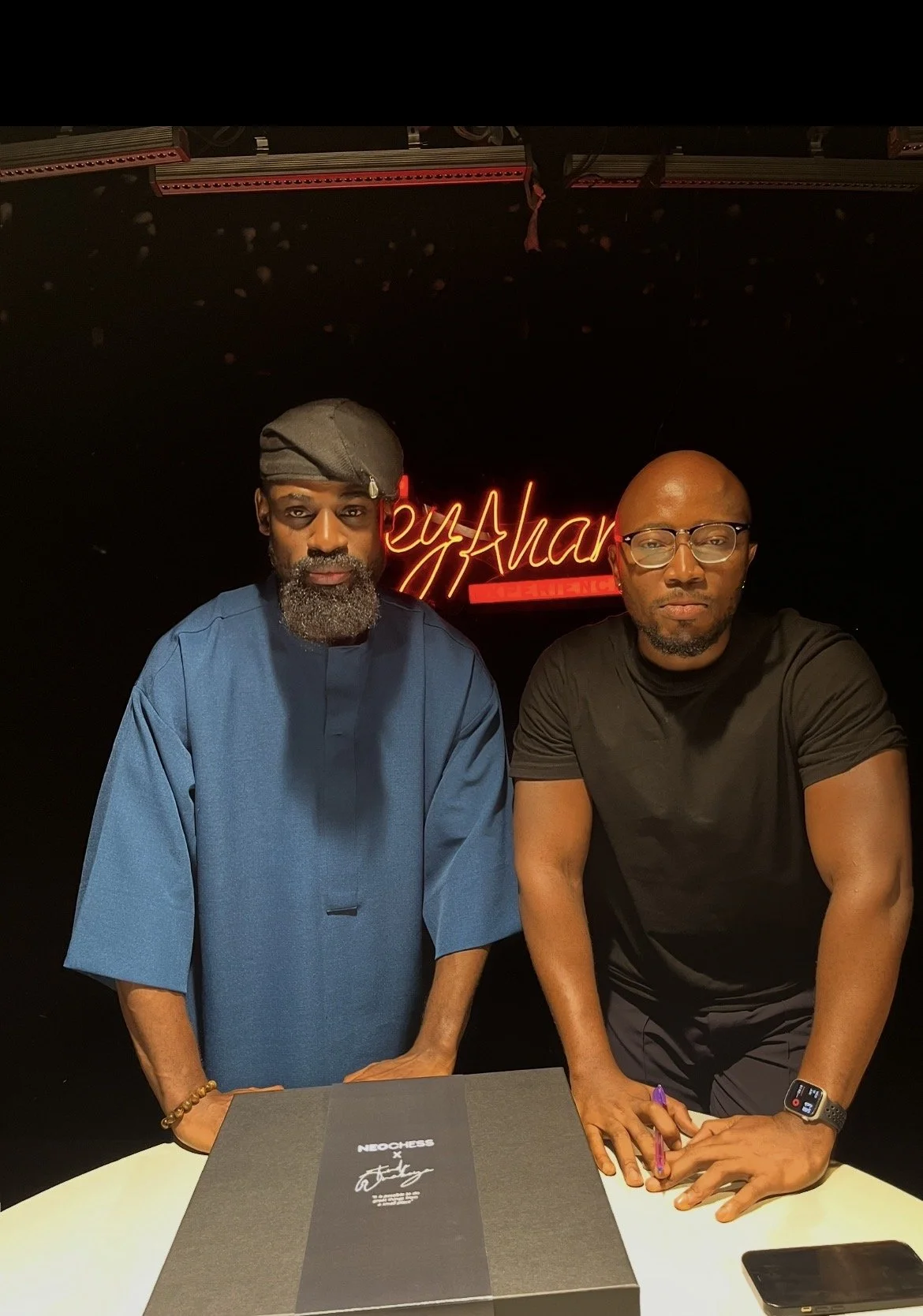
”Tunde Onakoya on The Joey Akan Experience.”
____________
The Joey Akan Experience was created by Joey Akan and produced by Úrú Collective. Úrú Collective is a talent management and media production company working with talent, brands, and culture across Africa.