

The rapper on refusing to chase inauthenticity, building Iyoo Cartel for the streets, and why the Eastern Nigerian music industry needs structure more than money.
Saving himself, as it turns out, has always meant getting out. Jeriq hails from Eastern Nigeria’s Enugu State – far from the Lagos lifestyle of entertainment and hurried survival. Jeriq is colored by his ambition and Igbo roots. He sat down on Afrobeats Intelligence with host, Joey Akan, to explain how a kid from a tough neighbourhood became a name in the mainstream without relinquishing the community that made him.
Making It Out
Jeriq was born in Anambra State, in what he calls a very tough neighbourhood. "Everybody from my neighborhood wants to make it out of there," he says. "Making it out has always been the topic." Music wasn't the obvious route. Most people around him chose business, and the few who tried music, he says, "I would not say that they failed, but we did not see them at that high level." In one of his songs he calls himself the first star from his neighbourhood, and he says that is literal. "We don't have any figure that made it out in music."
What he had was conviction. "I have no option than to win," he says. When uncles and aunties visited and gave pocket money, he'd ask his siblings to hand theirs over to him. "Just believe me, I will make it and I will pay back." As the first in his family to try music, he saw himself laying a foundation so his brothers could see what was possible through music.
The EP That Dropped Into a Lockdown
His breakthrough arrived in strange conditions. Hood Boy Dreams was released during COVID, when everyone was at home and there were no shows to test a song against a crowd. "We were at home, so I could not get feedback from the streets to know how the EP is doing," he says.
Then restrictions eased. "The way people started treating me started changing. People started coming to me to take pictures." He remembers one show where the crowd's reaction floored him. "I could not believe it. I almost even cried."
The community behind that moment had been built on Audiomack. "In the East, before you even see money from Apple Music or Spotify, Audiomack is free," he says. "Me and my community were listening to Audiomack." He is wary of social media as proof of anything. "I'm more of a real-life person," he says. "Things on social media can be faked." What came next, in his words: "New level, new devil." He knew he had to go harder, which meant bigger shows and stadium concerts, because people now expected more.
Why He Still Lives in Enugu
Despite the traction in Lagos, Jeriq didn't move. "I'm still living in Enugu," he says. "I just come to Lagos to do the music business and still go back." The reason is practical and personal. "Even though I am a star, my community is what made me a star." He also finds Lagos hard to read. "I feel like Lagos is a bubble."
It's also where the music comes from. "I make music for the streets," he says. "And for me to make music for the streets, I need to experience the streets so that it won't be fake. It will be real."That means evolving carefully, he says. He isn't rapping only about the East's street life anymore, "because whether I like it or not, I have to grow," and he wants his community to know why.
A Book With Chapters
He describes his catalogue as a story. "My music is just like a book," he says. "It has chapters." Hood Boy Dreams was chapter one, and some of its dreams came true. Billion Dollar Dream was chapter two, with bigger ones.
That album is also where he turned down advice. He had recorded it in Enugu and brought it to Lagos, and the people he met liked it, he says, but suggested changes: some Afrobeats features, a different way of singing. "This is not who I am," he told them. "If I do it, it will be fake to me." He flew to Lagos four times for meetings and refused to allow his location to be a barrier to his career goals. "Staying true to my art is very important to me, because that's actually the reason I am who I am today."
Balancing the Equation
Staying true doesn't mean staying still. On a summer trip to Europe, on a yacht in Portugal, he heard the music people around him were playing and decided he wanted to make sounds they could vibe to as well. He knows some in his own community aren't happy about it. "Will you believe that some people in my community are not happy about it?" he says. His answer is practical: "You have to play the game even if you want to be true. You have to at least balance the equation."
Europe, he says, did more than inspire a sound. "It makes me see farther than I thought."* It also showed him how far he still had to go. "What I'm doing back [home] is not actually enough. I have to do more."
When asked whether performing in Igbo still limits an artist, he says the conversation has changed. "People are more open-minded now," he says, and credits the social media era with widening what people listen to.
The East Needs Structure
Jeriq doesn't pretend the East has the same infrastructure Lagos does. "What we are doing in the East is crazy," he says. "80 to 90% of the boys that are doing those crazy things are independents." Imagine, he says, if there were an ecosystem to support them.
The problem isn't money first. "Not money primarily, I would say access. Access and structure," he says. "You can spend money on promotion. If there is no structure, it won't go well." The talent is there across Enugu, Anambra, Ebonyi, Abia and Imo, he says, and many of its artists end up in Lagos because there is "no structure back home." If there were locally established organizations similar to Mavin Records in Lagos, he thinks more artists would say where they're from and be backed by local infrastructure in growing their careers.
Community, Without a Plan
Asked how he built such a loyal community, Jeriq says there wasn't a strategy. "I will not say that there was a rollout strategy. There was no plan," he says. When he released Hood Boy Dreams, "I used my phone to upload it on Audiomack." He has no manager, he says, but he built a team. What he does have is a connection to people who hear themselves in his music. "Listening to my music, it would be like you are listening to yourself."
That's the idea behind Iyoo Cartel. The label and brand takes its name from a word his community uses for young people on the hustle. "I wanted something that my fans, my community can relate to, can be part of," he says.
From Cutting Polos to Pop-Ups
Fashion was there before the brand. As a teenager he brought clothes to the market and customized them: "I would cut [the clothes] and style it like designers."
The business started after one of his songs took off and people began asking where he got his clothes. He bought plain polos, had a logo put on them, and sold three or five pieces at shows for five or ten thousand Naira each. "The demand was 100% organic. That's how the brand naturally grew to this level." His brother is the company's vice president and runs most of the operations. The designs are Jeriq’s original ideas. "The creative aspect is me 100%." He is also looking for a creative director. "God give me that person,"* he says. "There's billions to make in this industry."
Scaling it wasn't hard, he says, because his friends wore it first. "They didn't need any validation from any big star or any big brand."Now fake Iyoo chains turn up at shows across Nigeria.I feel like that's the price for success." He has lost count of how many songs mention the brand, and he jokes he'd love to throw a tattoo party for everyone who has the logo inked on them. He keeps the prices low on purpose. "My friends are from the street. As much as we want to make money, I still don't want them to lose connection to my [community]."
The pop-ups follow the same instinct. Each one draws on his childhood. His Lagos pop-up was themed "August Meeting" after the Catholic women's gatherings his mother's generation attended. His song Jehovah was inspired by My Book of Bible Stories, the golden-covered book with red script that many Nigerians remember, and he says he changed the artwork after receiving a cease and desist from the Jehovah's Witnesses organisation. "I love the church a lot," he says. "I don't even want to fight with the church."
A Symbol of Hope
Asked what keeps him going now that he's out, he returns to where he began. "My music is to motivate the streets," he says. "I also see myself as a symbol of hope." People tell him his music serves as a wake-up call, he says, and he embraces his music as a challenge to himself. What's next is more of the same, at a larger scale: "Showing them the life that they don't know exists, showing them that we can still go higher." He wants to show that "it's possible to actually perform in a stadium in London" and in Australia, and that "it's possible to actually expand globally."
The ambition has roots. He loves Travis Scott and Kanye West, each for different reasons, and the stadium shows they sell out. "I feel like if these people can sell out stadiums in their city, and leave their city and go to another place, it's possible that I can replicate it." His plan is to sell out his own state first, then others, then leave the region. It also came from a gap at home. Live shows had dried up in the East, which he says was due to propaganda about insecurity that overstated the environmental conditions. "So I was like, I have to take this on." He set out to bring live shows back.
Jeriq started with a dream of making it out. Now, he is focused on increasing capacity, dreaming even bigger and building spaces to continuously uplift his community.
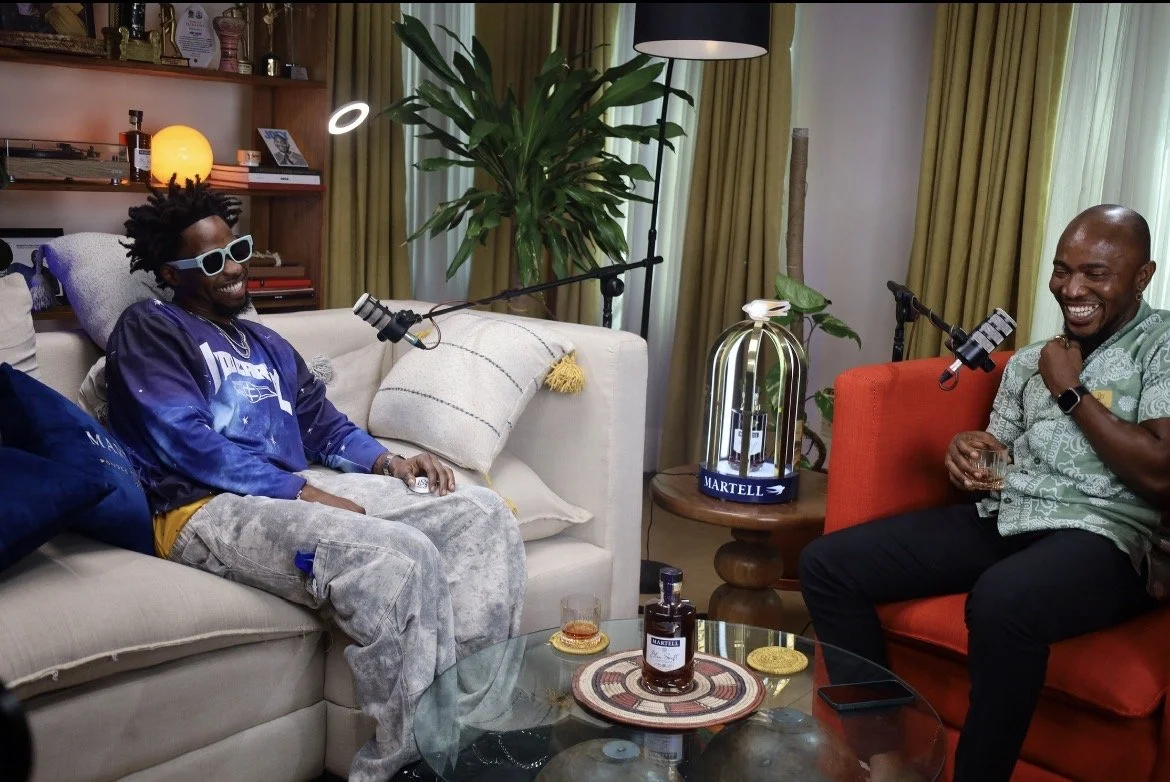
“Jeriq and Joey Akan in conversation on Afrobeats Intelligence.”
Watch the full conversation with Jeriq on Afrobeats Intelligence presented by OkayAfrica and sponsored by Martell.
____________
Afrobeats Intelligence presented by OkayAfrica was created by host, Joey Akan and produced by Úrú Collective. Úrú Collective is a talent management and media production company working with talent, brands, and culture across Africa.