

The Emmy-winning filmmaker on how a VR experiment led to venice Emmy-winning filmmaker on how a VR experiment led to Venice, why he spends years embedded with the people he films, and why pity is a useless emotion.
Kachi Benson almost didn't open the email.
It had come from the Venice Film Festival , two weeks after he'd submitted a film he never thought belonged there. So he went for a walk instead, because he knew how those emails go: either they congratulate you or they tell you nicely that you couldn't cut it. When he finally returned and opened it, it said "Congratulations!" He didn't know it then, but his film was set to be the first African VR film to play at the festival.
The documentary filmmaker sat down on The Joey Akan Experience to talk about that email, the Emmy that came later, and the idea that connects everything he makes. "I want my films to move people from empathy to action," he says.
How a Client's Request Became a Career
None of it was planned. A client in Lagos asked him to make a 360 video. "I don't even know what it means," he told her. She told him to go and do his research. He did, decided it wasn't something he did, and told her so. "Well, I want you to be the one to do it," she said. He had been doing work for her for years, and she trusted him completely. As he was leaving the room, she called him back: "Do this thing. It will change your game."
He couldn't find anyone in Nigeria doing it. The nearest training was in Europe and America, and his US visa was still valid, so he told his wife he had to go. "She knows that I'm kind of crazy like that," he says. He spent about four weeks there, trained, and bought a 360 camera that was basically six GoPros stitched together. Then he put on a VR headset for the first time. It was a Coldplay concert, and "it felt like I was in the room with them." He knew immediately what it was. "What a tool for storytelling."
He came home and went north, where he does much of his work in the development sector, focused on the impact of war and terrorism on women and children. His earlier films never quite captured what he had experienced there. "With VR it was different," he says. "Now I can take people there." His first VR film premiered at the Cairo Film Festival . In 2018 and 2019, he made Daughters of Chibok. The goal was never to be first at anything. "The intention was go there, learn this thing, come back and satisfy my client."
The Email He Didn't Want to Open
A friend told him to submit Daughters of Chibok to Venice. He said no. "Do you know what the Venice Film Festival is?" he remembers telling her. She wouldn't let it go. "You submit it or I submit on your behalf." So he did, and two weeks later the email arrived.
The surprises kept coming. Two days before the festival ended, he ran out of money and called the organisers to say he needed to go home. A curator told him not to worry and offered him a place to stay. He asked whether he could get an invite to the closing ceremony, just for the experience, which is normally for winners. The morning of the ceremony, the curator told him he couldn't keep it from him any longer: "You're going to be winning an award."
"We're standing in this kitchen, I'm looking out the window, and I'm just like tears in my eyes," Benson says. "It's really surreal." He didn't even have a suit. His answer to that: "I didn't have any suit here, so let's not even go there."
He is careful about what he takes from that day. "When you go into something with just the mindset that I want to create something beautiful, I want to create something meaningful, whatever comes afterwards is just icing on the cake," he says. "My biggest reward was being able to even make the film in the first place, and for it to have the impact that it had in the community." Accolades, he adds later, are the same. "It's a nice to have, but it doesn't drive anything. It's all about impact and service."
Books Were the Escape
His route to film began somewhere else. He grew up with little access to it. "I didn't have access to films that much because I grew up disadvantaged," he says. Books were the escape, and nobody valued them, which meant people threw them away. He scavenged them from rubbish heaps and asked people moving house to give him theirs.
Then his mother died a few days before his university entrance exams, and that ended his plans for university. He spent a couple of years drifting. "You realize that your family is all you got," he says. At 17 or 18, trying to figure out life, he describes it as tough. Then a friend took him to a film set.
"I remember seeing this young guy, must have been in his mid-20s at the most, calling the shots on set," he says. "He seemed so much in control." For a teenager who felt he had no control, that was the hook. "Life was just happening to me." He kept going back. He started hanging around older film people, sitting at the back of the room while they watched and commented on films. "I would just soak it all in." Then he got his hands on a camcorder.
Not everything was possible. Three friends planned to travel overland to Europe, and their fathers had raised the money for it. He had no one to ask. "I still remember that morning," he says. They left and he stayed. One of them later came back, and he sold him on buying an editing machine. "I would sit on this machine for days just trying stuff out." Looking back, he says, the path looks neat, but at the time it was one day at a time, until ten years had passed.
Chasing the Feeling
Security came slowly. Asked when he stopped feeling out of control, he can't name a moment. "As you start to do something and do it over and over and over again, you realize more and more you're comfortable in this space," he says. There were bad days, too. He remembers a music video shoot on a beach where the equipment arrived late and the rain didn't stop until 7am. "By morning, we had shot maybe all of 15 minutes of footage," he says. He asked everyone to go home so he could have time alone. It's a funny story now, and his point is the moral. "You keep pushing. You don't let those things stop you."
Joey asks why realism became his subject, when a camera can go anywhere. "Because I was looking for inspiration," Benson says. "And fiction did not have enough." He had produced a TV series called Leadership and Lifestyle, which profiled people who had come from nothing, and he was blown away by the people he interviewed. "Okay, so it's possible for me." He started to wonder how many other people needed that dose of inspiration. Around then he was shooting weddings and a bride asked him to remove the pimples from her face. It wasn't his calling.
He started making short documentaries about people he liked and putting them on Vimeo. When he told his friends he was going into documentaries, they thought he was nuts. "The first question was, what is that?" And then: how would he make money? "I don't know, dude, but I know how I feel when I make it. I feel happy." He still works that way. "Just chasing that feeling is paramount," he says. "When you get that, you can figure out how to support it."
Why Tell Stories of Pain
Joey asks the harder question: why is he drawn to Nigeria's pain? Benson's answer starts with the country. "I think it's important to show how resilient we are as a people," he says. It is personal, too. "I think I'm an example of what it means to come out of a dark place and make something for myself, no matter how little. Those are the stories that I'm drawn to."
Take the Mothers of Chibok. "These are women whose kids were kidnapped because they were in school," he says. "In the last ten years, these women have not stopped sending their children to school." It isn't the story people usually hear, which is about loss. "I choose to tell the story of hope and courage and faith and love. Because I spend time with them. They laugh. They have moments of lightness." He doesn't deny the loss. "Some pain never goes away. It can recede, but then it comes back." What he rejects is the one-dimensional version. "We have a responsibility as storytellers from this part of the world to present a balanced picture of who we are."
He tests it on audiences. "What is the first emotion that you feel?" he asks them. "Nine times out of ten, what I get is admiration for the women." That's the point. "Not pity. Pity is a useless emotion."
Embedded, Not Extractive
How does he get people to trust a camera? Time. His approach is "somewhat like ethnographic," he says. He embeds himself, sometimes for two years, and he doesn't shoot interviews or talking heads. "It's just me and my camera. I'm in your life. Live your life."
Trust is something you earn actively. "You have to convince them that you genuinely care about their story, and not just helicopter in," he says. "This is not an extractive relationship." So you visit for a week, leave, come back a month later, and do it again. Eventually the children run to hug you. "Six months' time, you are there with your camera. They don't even know you're there. They are cracking jokes and they are living their lives." There was a lot of skepticism at the start, and he held meetings with the women to explain his intentions.
It doesn't end when the film does. "By the time the film is done, it has transcended director and subject. We're friends now. We're family." Most of his films have an impact campaign attached. When a film exposes a need, he shows it privately to people who can help. "Once I'm able to achieve that impact, I walk away, we stay friends."
At an IDP camp, what he noticed first was "the kids." He says "kids are the most resilient of all of us," even though some had watched relatives killed, and the child they filmed had PTSD. For him, hope looks small. "Girls playing and skipping. The boy who is riding his bicycle, and there's a skinny dog chasing him." Two kids walking hand in hand, laughing because they just got a meal. "You see those things and you're like, let me see what I can do."
The relationships keep him grounded. "They keep me grateful," he says. He tells his kids, half-joking, that he'll take them on his next shoot so they can see how other people live. He wants them to see it. He also spends time with people in high-rises and with his guys in the street, and says the mix "gives you a very balanced perspective on life."
The Boy Who Wanted to Dance
The film that earned the Emmy, Madu, began in the pandemic, when he was bored and looking for something to do. An email arrived from a company in Los Angeles that was looking for a director. They told him about Anthony Madu, the boy who had gone viral dancing ballet in the rain. Benson met him and his mother, then went back to his friend Matt Huggins and said: "I met this kid. He's amazing at 11, and he has such a clear idea of what he wants to do." They co-directed it.
What drew him was how specific the dream was. "You can imagine what the kid had to go through in terms of the teasing and the mocking of his contemporaries and peers in school," he says. They were filming when Anthony got his scholarship, so Benson flew with him to the UK, and they followed him to school in Birmingham. They filmed for about a year. "What are the odds that you're going to make this video, it's going to go viral, and you're going to be living your dreams? If someone had scripted that, you'd be like, hmm."
It was also his first co-directing job, and it taught him collaboration. "You have to compromise for the bigger vision." Working with Disney was "a whole different learning curve," he says, and he treated it like film school. The structure of those productions explained something he'd wondered about: why films from other parts of the world look the way they do. "Their systems are structured. They are blueprints." That leaves room to focus on being creative, with "a huge demand for excellence."
He is particular about who edits his films. Madu had a female editor, Mothers of Chibok had two, and his next film has one. "I insisted that they had to be women and mothers," he says. His films are emotional, and the editor has to live with them. "Your editor knows your film more than you, the director," he says, because you remember some of the shoot but they've watched every frame.
Legacy for Inspiration
Joey asks what matters most now. Benson takes a while. "Legacy is important," he says. "Not legacy for legacy's sake, but legacy for inspiration." He recalls an incident that made him ask himself what he'd have to show his kids if he were gone. "What have you done that your kids can remember you for? I couldn't point to anything at the time."
Now he wants to keep making films "that truly intersect storytelling and social impact," and to teach. "I want to be more intentional about mentoring and training the next generation of filmmakers, especially factual filmmakers," he says. "It's like an all-consuming idea for me." Most of the people who work with him have already been through his training programme. He wants to formalizse it, so that a young filmmaker who cares about film and about issues can look at his work and say that film can be the vehicle.
Joey tells him he has sold hope. The line Benson opens the episode with sums up how he got here. "There's no one who's coming to save you," he says. "Just go out there and start, and then the rest will figure themselves out."
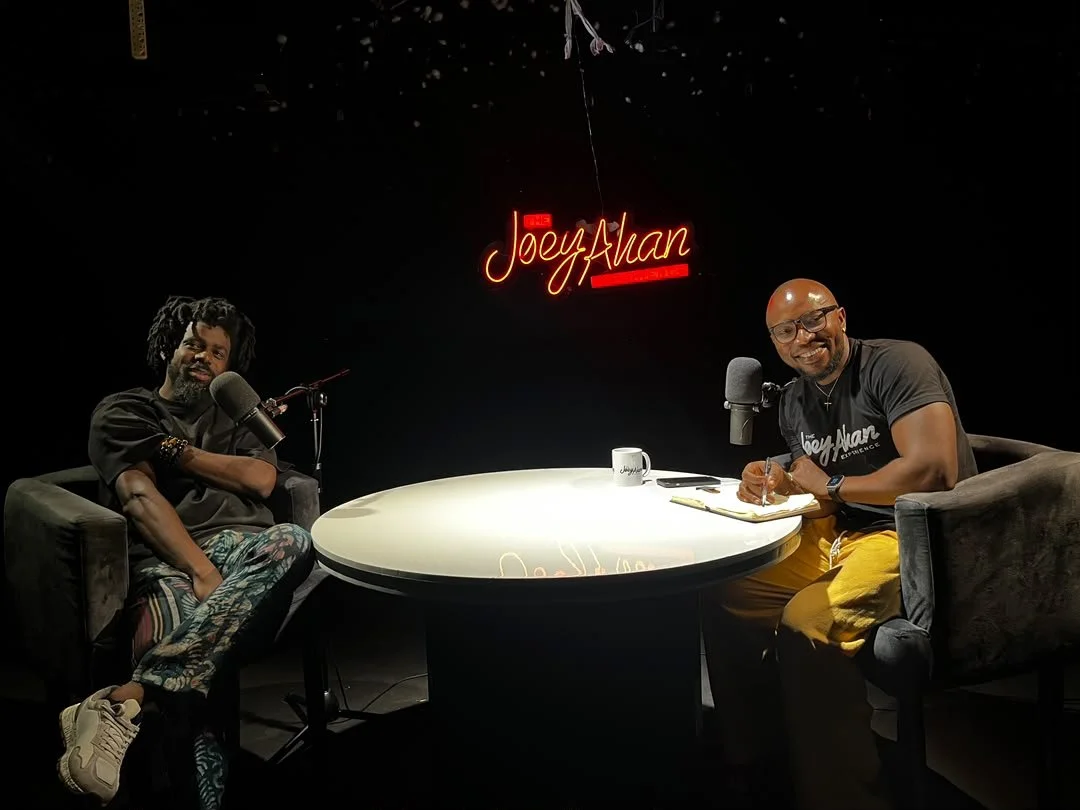
"Kachi Benson on The Joey Akan Experience."
____________
The Joey Akan Experience was created by Joey Akan and produced by Úrú Collective. Úrú Collective is a talent management and media production company working with talent, brands, and culture across Africa.